

Thread Turning Inserts: The Complete Guide to Thread Forms, Profiles & Grades
A thread turning insert is a small, replaceable carbide tip that cuts a screw thread on a lathe, one pass at a time, as the tool tracks along the workpiece in sync with the spindle. It is the most flexible way to single-point a thread: change the insert and the same holder cuts internal or external, right or left hand, in steel, stainless, titanium or aluminium. The first decision is the thread form on the drawing (Metric, UN, Whitworth, BSPT, NPT, ACME and the rest), the second is full profile or partial profile, and the third is the carbide grade for the material. Get those three right and the thread fits the gauge first time. This guide walks through all of it, with the thread forms broken down and the Carmex insert range mapped to each one.
In this guide
- What is thread turning?
- How a thread turning insert works
- Full profile, partial profile or multi-tooth?
- Thread forms explained: which insert for which thread
- How to read a threading insert designation
- Carbide grades and coatings by material
- Infeed, passes and a clean finished thread
- FAQ
What is thread turning?
Thread turning is single-point threading on a lathe or CNC turning centre. The insert makes a series of light passes along the thread, the carriage advancing exactly one pitch for every spindle revolution, until the form is cut to full depth. It produces internal and external threads on more or less any material, from free-cutting brass to Inconel and hardened steel.
Taps and dies still have their place. For an M6 in mild steel at volume, a tap is quicker and cheaper per hole. A threading insert wins when the thread is large, the material is tough or expensive, the tolerance is tight, or the form is unusual. There is no tap to snap off inside a finished part, you adjust thread depth from the control rather than swapping tools, and one holder covers a huge range of sizes and pitches.

How a thread turning insert works
Most thread turning inserts are laydown triangular tips that clamp into a holder over a shim, with the cutting edge presented at the helix angle of the thread. The insert carries the thread form ground into its tip. As the tool feeds along the part in time with the spindle, that form is reproduced as a helical groove. Because the insert sits in a standard holder, swapping form, hand or grade is a 30 second job at the turret.
Three things decide whether the thread comes out right: the form ground on the insert has to match the standard, the carbide grade has to suit the material, and the holder has to present the edge square to the part with the correct shim so the helix angle is right. The rest is feeds, speeds and infeed, covered further down.

Internal and external Carmex inserts for every thread form, from M0.5 micro threads to coarse ACME and Trapezoidal. Browse by form, pitch and hand.
Full profile, partial profile or multi-tooth?
This is the choice that catches people out, so it is worth being clear. It decides how many thread standards one insert can cut and how good the crest comes out.
Partial profile. The insert cuts the flanks and the root but not the crest, so a single 60 degree (or 55 degree) insert covers a whole range of pitches at that thread angle. This is the versatile, low-stock option, ideal for a jobbing shop seeing many different threads. The trade-off is that the crest is left as whatever the turned diameter was, so you have to turn the major diameter to size first. Carmex partial profile inserts handle pitches up to 9.0 mm, with miniature inserts down to 0.5 mm.
Full profile. The insert carries the complete form including the crest, so it finishes the thread to standard and the major diameter is formed for you. Accurate and fast, but each insert is tied to one pitch and one standard. This is the production choice when you cut the same thread again and again. Carmex full profile covers every common standard and pitches up to 12.0 mm.
Multi-tooth (full profile). Two or three cutting teeth per side, each taking a little more depth, so the thread is finished in fewer passes. It cuts cycle time hard on longer threads in stable setups, for pitches roughly 1.0 to 3.0 mm. You need the rigidity and the clearance to use it, so it suits external work and stronger parts.
There are also chip-controlled versions (Type B with a ground profile plus a sintered chip-breaker, and sintered Type K with an integrated chip-breaker) for when chip flow is the problem, and a Large Profile range for coarse Trapezoidal, Buttress and ACME pitches that need their own holders. If you cut a lot of different threads, start with partial profile. If you repeat one thread in volume, full profile pays for itself.
| Insert type | Cuts the crest? | Best for |
|---|---|---|
| Partial profile | No, turn major dia. first | Mixed work, many pitches, one insert per thread angle |
| Full profile | Yes, finished to standard | Repeat production of one pitch and standard |
| Multi-tooth | Yes | Cutting cycle time on longer, stable threads |
Thread forms explained: which insert for which thread
The thread standard on the drawing fixes the flank angle and the form, and that decides the insert. Below are the forms you will actually meet, grouped by family, with the angle and where each one turns up. You can browse every form on the thread turning inserts page and filter by internal or external.
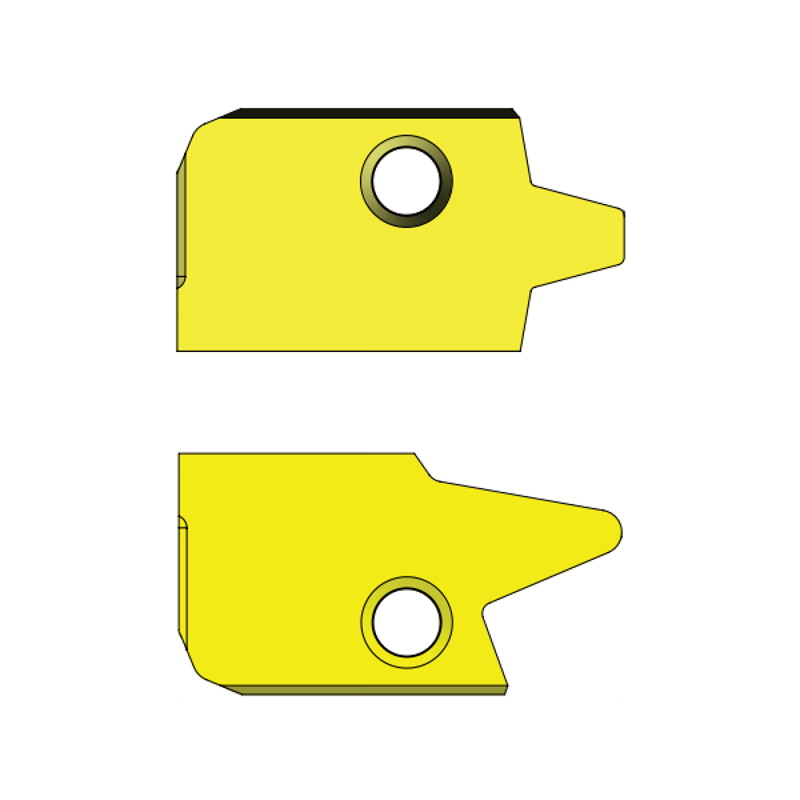
60 degree V-threads. The most common family. Metric ISO and the Unified series (UNC, UNF, UNEF) are both 60 degree symmetric V-forms, used across general engineering and on US-spec parts. UNJ and MJ are the controlled-root-radius versions for aerospace and fatigue-critical work, where the larger root radius lifts fatigue life. A 60 degree partial insert covers the lot for mixed pitches; a full profile ISO or UN insert finishes a single repeated thread.
55 degree Whitworth and pipe threads. Whitworth (BSW and BSF) is a 55 degree rounded form still common in legacy and restoration work. BSP, also written G, is the 55 degree parallel pipe thread for fittings, and BSPT (R) is its tapered cousin for sealing joints. These all want a 55 degree insert, partial for variety or full profile for repeat pipe work.
Tapered pipe and sealing threads. NPT and NPTF (dryseal) are the 60 degree American tapered pipe threads used for pressure seals, with NPSM/NPS as the parallel versions. The taper does the sealing, so these are nearly always cut with form-specific inserts.
Power transmission and load-bearing forms. ACME (29 degrees) and Stub ACME drive lead screws and actuators. Trapezoidal, DIN 103 (30 degrees), is the metric equivalent. Buttress and American Buttress are asymmetric forms built to take load in one direction, used in clamps, presses and breech fittings. Sagengewinde (DIN 513) is the German buttress form. These coarse forms often need the Large Profile range and matching holders.
Specialist and industry forms. API round and buttress casing threads for oil and gas, premium connections such as VAM, Round forms to DIN 405 and DIN 20400, and PG (Panzergewinde) for electrical conduit and cable glands. Carmex grinds inserts for all of them, which is the real reason to single-point rather than hunt for a tap.
| Thread form | Angle | Where you see it |
|---|---|---|
| Metric ISO | 60° | General engineering, most common |
| UN / UNC / UNF / UNEF | 60° | Imperial and US-spec parts |
| UNJ / MJ | 60° | Aerospace, fatigue-critical threads |
| Whitworth (BSW / BSF) | 55° | Legacy and restoration work |
| BSP (G) / BSPT (R) | 55° | Parallel and tapered pipe fittings |
| NPT / NPTF / NPSM | 60° | Tapered pressure seals, US pipe |
| ACME / Stub ACME | 29° | Lead screws, actuators, vices |
| Trapezoidal (DIN 103) | 30° | Metric power transmission |
| Buttress / American Buttress | Asymmetric | High one-direction load, presses |
| API / VAM | Form-specific | Oil and gas casing and tubing |
| Round (DIN 405 / 20400) / PG | Form-specific | Rough service, conduit and glands |
Full and partial profile, internal and external, in grades for steel, stainless, titanium and aluminium. Filter by pitch and hand.
How to read a threading insert designation
Insert codes look cryptic until you know the pattern, and once you do, ordering the right one is straightforward. A typical laydown insert reads something like 16 ER 1.5 ISO BMA. Here is what each part means.
| Code | Means |
|---|---|
| 16 | Insert size (inscribed circle). Common sizes are 11, 16, 22 and 27, matched to the holder and the lathe |
| E | External thread. I means internal |
| R | Right-hand thread. L means left-hand |
| 1.5 | Pitch in mm (or TPI on inch inserts). On a partial insert this is the pitch range it covers |
| ISO | Thread form. AG60 is partial profile 60°, AG55 is partial 55°, then ACME, TR, NPT, W and so on |
| BMA | Carbide grade and coating (see the next section) |
Two quick rules save mistakes. The E/I letter must match the job, an external insert will not cut a bore. And the insert size must match the holder: a size 16 insert and a size 22 holder do not pair up, even though they may cut the same thread. Internal threading inserts are held on a boring-bar-style holder sized to clear the bore, so check the minimum bore diameter before you order.
Carbide grades and coatings by material
The grade is what makes the insert last in your material. Running a steel grade in titanium, or an uncoated grade at high speed in stainless, is the fastest way to scrap edges. Carmex uses a clear set of grades, and matching them to the material is most of the battle.
| Grade | Coating | Best for |
|---|---|---|
| BLU | PVD triple layer | All-round first choice: stainless, cast iron, titanium, non-ferrous, high-temp alloys |
| BMA | PVD TiAlN, sub-micrograin | Stainless and exotics at medium to high speed |
| HBA | Sub-micron, high toughness | Hardened steel and cast iron up to 62 HRC, titanium, superalloys |
| P25C | PVD TiN | Treated and hard alloy steels (25+ HRC) at low to medium speed |
| MXC | PVD TiN, micrograin | Free-cutting untreated alloy steels below 30 HRC, stainless, cast iron |
| P30 | Uncoated | Carbon and cast steels at low to medium speed |
| K20 | Uncoated | Non-ferrous metals, aluminium and cast iron |
If you only stock one grade, make it BLU: it is the all-rounder that handles most of what comes through a general shop. Add HBA for hard and heat-resistant work, and K20 for aluminium and brass. There are also sintered chip-breaker grades (KMR and KBL) on the Type K inserts for when you need help controlling the chip.
Infeed, passes and a clean finished thread
A threading insert is only as good as the cycle around it. The thread is cut over several passes, stepping deeper each time, and how you feed in matters as much as the speed.
- Radial (plunge) infeed. The insert feeds straight in, both flanks cutting at once. Simple and accurate, fine for small pitches, but it loads the nose and chips can be stringy on coarse threads.
- Flank or modified flank infeed. The insert feeds in along one flank (usually a degree or two off the true angle), so the chip forms like a turning chip and clears cleanly. This is the go-to for coarser pitches and tougher materials, and most G76 cycles let you set the infeed angle.
- Incremental and alternating-flank infeed. Used for large pitches and ACME, sharing the wear across both edges and keeping cutting forces sensible on deep forms.
A few habits that keep threads in spec: take the pass count from the insert maker's data rather than guessing, finish with a spring pass at the same depth to clean up deflection, get coolant into the cut in stainless and titanium, and gauge the first part before you run the batch. With a partial profile insert, remember to turn the major diameter to size first, because the insert will not cut the crest for you.

External and internal holders matched to every insert size, plus ready-made thread turning kits with holder, inserts and shims.
Frequently asked questions
What is the difference between a full profile and partial profile threading insert?
A full profile insert cuts the complete thread including the crest, so it finishes the thread to standard, but it only works for one pitch and one standard. A partial profile insert cuts the flanks and root but not the crest, so one insert covers a range of pitches at the same thread angle and you turn the major diameter to size first. Full profile suits repeat production, partial profile suits mixed work.
Can one threading insert cut different thread sizes?
A partial profile insert can, within limits. It covers a range of pitches at its thread angle (for example a 60 degree partial insert handles several metric pitches), so one insert does the job of many. A full profile insert is fixed to a single pitch and standard because it forms the crest as well.
How do I read a thread turning insert code like 16ER?
Reading left to right: the number is the insert size, E is external (I is internal), R is right hand (L is left hand), the next figure is the pitch in mm or TPI, and the letters after that are the thread form and the carbide grade. So 16ER 1.5 ISO is a size 16 external right-hand insert for a 1.5 mm pitch ISO metric thread.
Can the same insert cut internal and external threads?
No, the insert is specific to one or the other: external inserts (E) are presented differently from internal inserts (I), and internal inserts sit on a boring-bar holder sized to clear the bore. The holder and the threading cycle, though, cover both, so you only change the insert and holder, not the approach.
How many passes does a threading insert need?
It depends on the pitch, material and form, but coarser threads and tougher materials need more, smaller passes. Use the pass count from the insert manufacturer's data, then add a spring pass at final depth to clean up any deflection before gauging.
Are threading inserts better than taps and dies?
For large threads, tough or expensive materials, tight tolerances and unusual forms, yes: there is no tool to break in the part, you adjust depth from the control, and one holder covers a huge range. For small threads in free-cutting material at volume, a tap or die is faster and cheaper. Most shops run both.
Get the right thread turning insert on the lathe
Carmex inserts for every thread form, internal and external, full and partial profile, in stock in the UK.
Shop thread turning inserts →Free UK delivery on orders over £50.


