


ISO Turning Inserts
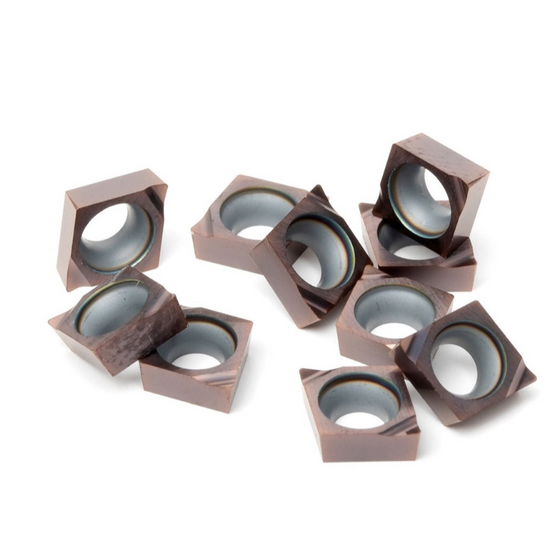
2,452 carbide turning inserts in 18 ISO shapes, from Palbit, Vortex and Omega. Pick by the shape you already run, or work down from the material you are cutting.
- 2,452 inserts, 18 ISO shapes
- Order before 4pm, ships same day
- Palbit, Vortex and Omega
- Technical help on 01732 887334
Shop by insert shape
All 18 ISO shapes we stock. If you already know your code, start here — the first two letters of any designation are the shape and the clearance angle.

CC Style
The positive 80°. Low cutting force with a strong corner, which makes it forgiving on thin wall and slender work.
Shop CC Style
CN Style
Strong 80° corner, double-sided. The default for roughing and heavy general turning when you have the power to drive it.
Shop CN Style
DC Style
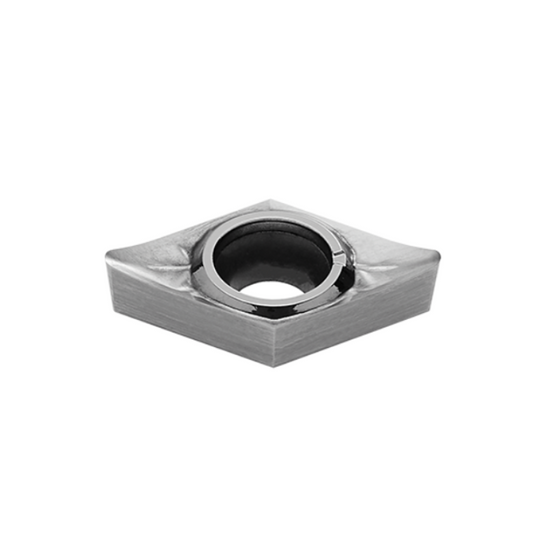
The positive 55°. Reaches into profiles and undercuts, and cuts light enough for an unstable setup.
Shop DC Style
DN Style
Double-sided 55° rhombic, and the single biggest line we hold. Enough point angle for general turning and profiling, enough edges to stay economical.
Shop DN Style
KN Style
Parallelogram, for heavy roughing and rail work. Two usable corners with a lot of metal behind each.
Shop KN Style
RC Style
No corner to break, so it is the strongest edge you can run. Copy turning and heavy radius work at high feed.
Shop RC Style
RN Style
Double-sided round. Maximum edge strength, for heavy copy turning and cast iron.
Shop RN Style
SC Style
The positive square. Four corners, with lower cutting force than an SNMG.
Shop SC Style
SN Style
Four strong 90° corners. Facing and heavy roughing, where the edge has to survive an interrupted cut.
Shop SN Style
SP Style
High-clearance square. A specialist item, mostly older machines and particular facing jobs.
Shop SP Style
TB Style
Small-clearance triangle and a genuine specialist — check what your holder takes before ordering.
Shop TB Style
TC Style
Single-sided and free-cutting. The positive triangle, for smaller machines and lighter work.
Shop TC Style
TN Style
Three corners a side, six per insert. The cheapest cost per edge here, though a 60° point is weaker than a C or a W.
Shop TN Style
TP Style
High-clearance triangle for aluminium and light finishing, where a 7° insert would rub rather than cut.
Shop TP Style
VB Style
The same 35° geometry as a VCMT but with 5° clearance instead of 7°. Match whichever your holder takes.
Shop VB Style
VC Style
Sharp 35° point for contours and tight internal corners. A finishing tool — it will chip if you rough with it.
Shop VC Style
VN Style
Double-sided 35°, for profiling where you want the extra edges and have the rigidity to use them.
Shop VN Style
WN Style
Six edges with an 80° corner behind each. Roughing economy without the fragility of a triangle.
Shop WN StyleShop by operation
Roughing wants a strong edge and a big nose radius, finishing wants a sharp edge and a small one. Most work sits in the middle.

Finishing
Sharp edge, close tolerance, good surface. Feed has to stay under about half the nose radius or the finish goes off regardless of which insert you fitted.
Shop FinishingMedium
Where most turning actually happens. Balanced edge strength and chip control, and the safest choice when you are not sure.
Shop Medium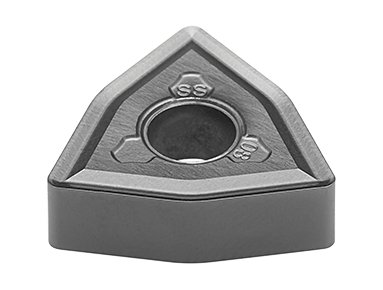
Roughing
Strong corner, thick insert, open chipbreaker. Built to take a heavy cut and an interrupted entry without chipping.
Shop Roughing
General Purpose
Vortex geometries that will rough and finish acceptably rather than either brilliantly. Sensible for a jobbing shop or a single machine.
Shop General PurposeShop by what you're cutting
The ISO groups, in the colours the standard actually uses. Grade matters more than shape — an insert cut for cast iron will not last in stainless, whatever the geometry.

Steel (ISO P)
The biggest part of the range. PHG and PH5 grades, tuned for continuous cutting where heat is steady and the chip flows.
Shop Steel (ISO P)Stainless (ISO M)
The grades people mean when they search for carbide inserts for stainless steel. Stainless work-hardens and grabs, so these run tougher substrates and sharper edges to keep the cut moving rather than rubbing.
Shop Stainless (ISO M)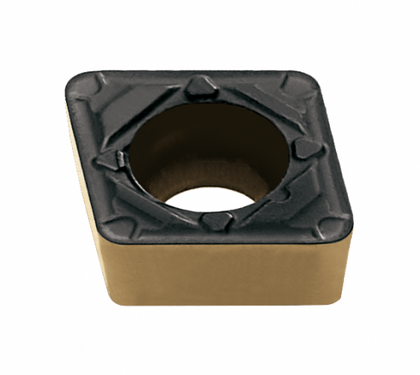
Cast Iron (ISO K)
Abrasive rather than sticky, so the wear mode is different. PH5705 and PH5320 hold an edge against it where a steel grade would round off.
Shop Cast Iron (ISO K)Aluminium (ISO N)
Polished, uncoated and very sharp, with a wide-open chipbreaker. Aluminium welds itself to a dull edge, so sharpness beats toughness here.
Shop Aluminium (ISO N)How to read an insert code
Every ISO turning insert carries the same seven-position code. Once you can read it, you can order the right insert from the designation alone — which is how most people find these.
| Position | What it sets | Example | Notes |
|---|---|---|---|
| 1 — Shape | Insert shape and point angle | C = 80° rhombic | D is 55°, V 35°, T 60° triangle, W 80° trigon, S square, R round. |
| 2 — Clearance | Positive or negative | N = 0° | N only fits negative holders. C is 7° positive. Get this wrong and it will not seat. |
| 3 — Tolerance | Dimensional tolerance class | M = medium | M is normal for turning. G is tighter, used where the insert sets a datum. |
| 4 — Form | Hole and chipbreaker form | G = hole plus chipbreaker | A has a plain hole and no chipbreaker, N has no hole at all. |
| 5 — Size | Inscribed circle in mm | 12 = 12mm IC | Nominal, not exact — a 09 insert is really 9.525mm. Must match your holder pocket. |
| 6 — Thickness | Insert thickness in mm | 04 = 4.76mm | Also rounded. Thicker resists a heavier cut. |
| 7 — Nose radius | Corner radius in 0.1mm | 08 = 0.8mm | The one that decides finish. Small for finishing and thin wall, large for roughing strength. |
Worked example — CNMG120408 is an 80° rhombic insert, 0° clearance so it only fits negative holders, M tolerance, G form with a hole and chipbreaker, 12mm inscribed circle, 4.76mm thick, 0.8mm nose radius. The size and thickness digits are rounded millimetres, which is the part people get wrong most often.


Turning insert FAQs
The questions our technical line gets asked most, answered properly.
How do I choose the right turning insert?
Work down in this order. Shape is fixed by the holder you already own, so start there unless you are buying both. Then size and nose radius, from your depth of cut and the finish you need. Then grade, from the material you are cutting — that is the ISO P, M, K or N choice further up this page. Then chipbreaker, from whether you are roughing or finishing. Get the last two wrong and the insert will still cut, it just will not last.
How do I read an ISO turning insert code like CNMG120408?
Seven positions, left to right: shape, clearance angle, tolerance class, hole and chipbreaker form, inscribed circle size, thickness, nose radius. So CNMG120408 is an 80° rhombic, 0° clearance, M tolerance, hole with chipbreaker, 12mm IC, 4.76mm thick, 0.8mm nose radius. The table above breaks each position down.
What does the 1204 in CNMG 1204 mean?
12 is the inscribed circle in millimetres — the diameter of the largest circle that fits inside the insert — and 04 is the thickness, 4.76mm. Both are rounded, so they are not exact dimensions. The IC has to match your holder pocket; the thickness is about how heavy a cut it will take.
Which insert do I need for stainless?
An ISO M grade — tougher substrate, sharper edge, and a geometry that keeps the chip moving. Stainless work-hardens the moment you let the tool rub, so the failure mode is usually a dull edge causing a hard skin rather than the insert wearing out.
What is the difference between a positive and a negative insert?
Position two of the code. N is 0° clearance, double-sided, so you get twice the edges but it needs more power and rigidity. C is 7° positive, single-sided, and cuts more freely — better on thin wall, slender parts and smaller machines. They are not interchangeable in a holder.
What nose radius should I use?
Small for finishing and anything slender, large for roughing. The working rule is to keep feed below roughly half the nose radius, so a 0.4mm radius tops out around 0.2mm per rev. A big radius is stronger and lets you push depth, but it also pushes the part away.
What do the grade codes like PHG125 or PHH920 mean?
They are Palbit's grade designations, and they map to material group. PHG and PHG140 are steel grades, PH5705 and PH5320 are cast iron, PHH910 and PHH920 are stainless and exotics, PH0910 is aluminium. If you know the grade you can work backwards to the material it was designed for.
Can I use a steel insert on cast iron?
It will cut, but it will not last. Cast iron wears an edge abrasively where steel wears it thermally, so the coatings and substrates are built differently. A cast iron grade on cast iron will often triple the edge life for the same money.
What is a chipbreaker and does it matter?
The moulded geometry on the insert face that curls and snaps the chip. It matters enormously — the wrong one gives you long stringy swarf that wraps the part, or forces so high they chip the edge. Finishing chipbreakers work at light depth and feed, roughing ones need depth to function at all.
Which holder does my insert fit?
The holder's designation encodes the insert it takes, and the shape and clearance letters have to match. A CNMG insert needs a holder with C in the insert-shape position and negative geometry. If you have the holder, tell us the code and we will tell you the insert.
Do you stock every size in every grade?
No — the range is 2,452 lines and we hold the common combinations. If a size and grade pairing is not showing, it is usually available to order in a day or two, so ring rather than assuming.
Not sure which grade you need?
Tell us the material, the operation and the holder you are running. We will tell you which insert and grade to order, and what feed and speed to start at.
