

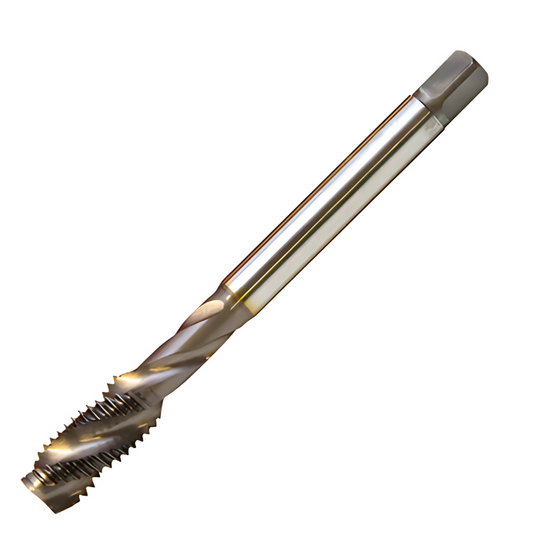
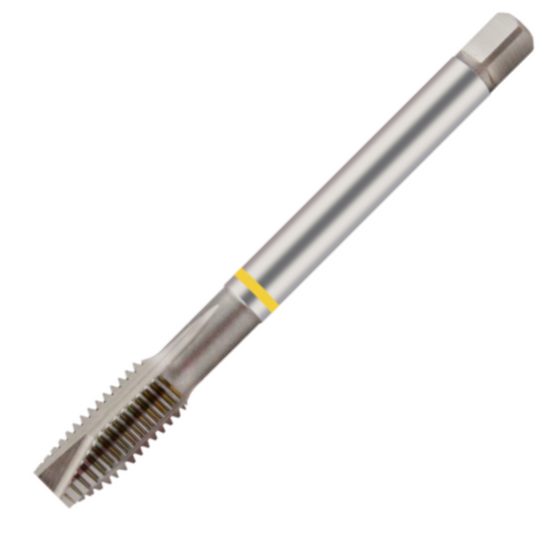
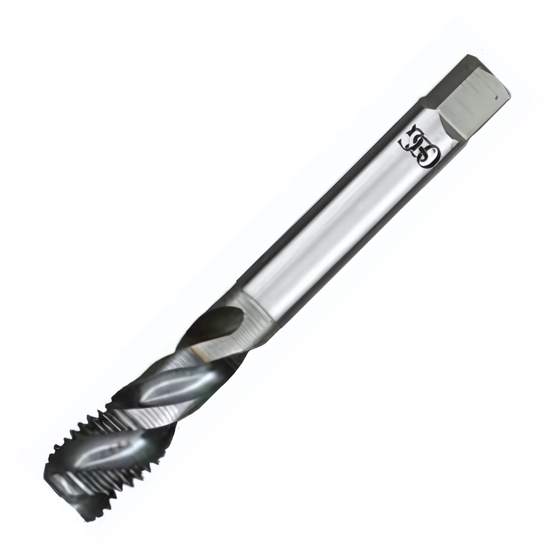
Threading Taps
Eleven thread forms, over 2,000 taps, all held in UK stock. Pick the form you're cutting and you get a filtered list rather than a search box and a guess — in HSS, HSS-E and solid carbide.
- 2,000+ taps in UK stock
- Order before 4:30pm, ships same day
- HSS, HSS-E and solid carbide
- Technical help on 01732 887334
Shop by thread form
Every collection below is filtered to a single thread form, so you're not sifting through two thousand taps to find one size. Flank angle and size range are listed on each card.

Metric
Coarse and fine pitch across the full range. If you are working on anything built in the last few decades, start here.
Shop Metric taps
BSP
The UK and European standard for pipe connections in hydraulic, pneumatic and plumbing work.
Shop BSP taps
BSPP
Seals on a bonded washer or O-ring rather than the thread itself. Standard on hydraulic ports with a flat face.
Shop BSPP taps
BSPT
Wedges and seals on the thread flanks with PTFE tape or sealant. Used across UK gas and plumbing installation.
Shop BSPT taps
BSW
The original British imperial thread. Still needed for classic vehicles, older machine tools and heritage restoration.
Shop BSW taps
BSF
Finer-pitch Whitworth for better vibration resistance. Common on pre-metrication British automotive and aero work.
Shop BSF taps
UNC
The main American coarse standard. Turns up on any imported plant, fixture or fastener built in North America.
Shop UNC taps
UNF
More threads per inch than UNC, so better engagement in thin sections and anything that vibrates.
Shop UNF taps
NPT
The American tapered pipe thread. Seals on the flanks with PTFE tape. Common on compressed air and imported machinery.
Shop NPT taps
NPSF
Dryseal straight thread for fuel and oil ports, cut to mate with an NPT external without a separate seal.
Shop NPSF taps
BA
Miniature threads for instruments, model engineering, older switchgear and fine mechanical assemblies.
Shop BA tapsShop by tap style
Thread form decides what thread you cut. Style decides how the tap clears its swarf — and that is usually what decides whether it survives the hole.
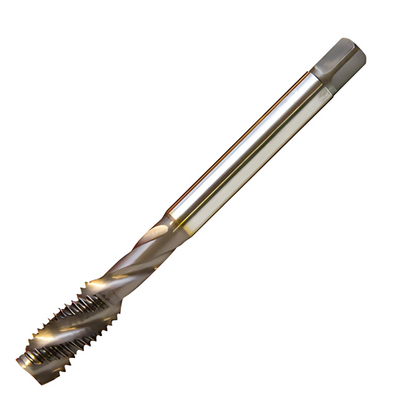
Spiral Flute
Pulls swarf back up and out of the hole. The one to reach for when the chips have nowhere else to go.
Shop Spiral Flute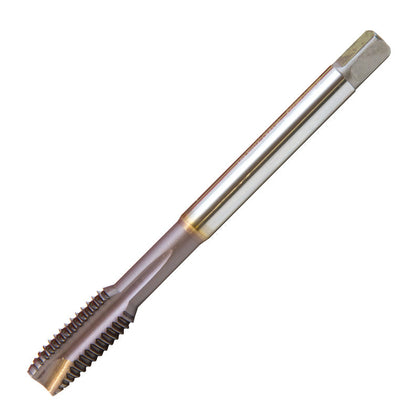
Spiral Point
Pushes swarf forward and out of the bottom. Fastest option on a machine, but only where the hole goes all the way through.
Shop Spiral Point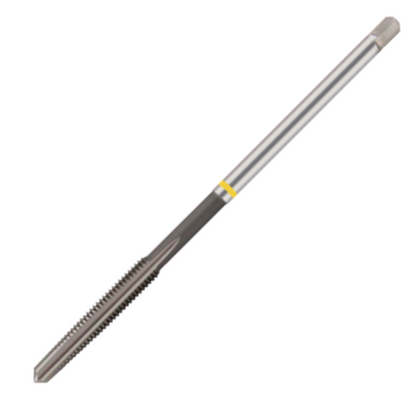
Straight Flute
The general-purpose choice, and what most hand sets use. Works well in short-chipping material like cast iron and brass.
Shop Straight Flute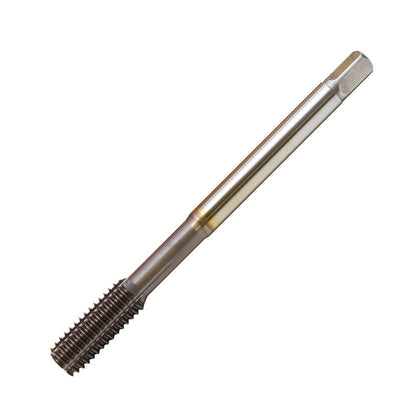
Forming Tap (Roll)
Displaces material instead of cutting it, so the thread comes out stronger and nothing has to be cleared. Ductile materials only, and it needs a larger drill.
Shop Forming Tap (Roll)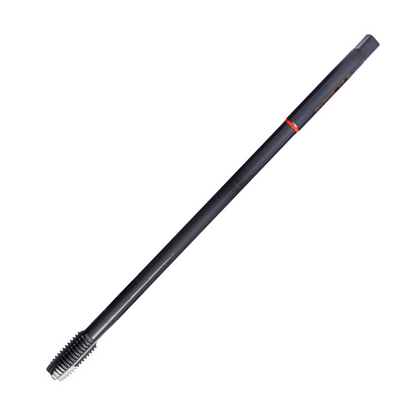
Long Series
Extended reach for holes a standard tap cannot get down to. Same cutting geometry, more length under the shank.
Shop Long SeriesShop by material
Colour coded to the ISO 513 groups marked on the tools themselves, so if you know the ring colour on the tap you already know where to look.
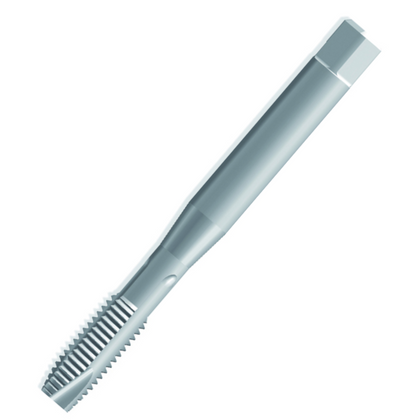
Stainless & General Steels
The bulk of general engineering work. Cobalt HSS-E handles it comfortably, and stainless wants a spiral flute in blind holes because the swarf comes off long and stringy.
Shop Stainless & General SteelsAluminium & Non Ferrous
Soft and gummy rather than hard. The problem is swarf welding itself to the flutes, so polished flutes and plenty of coolant matter more than tap hardness.
Shop Aluminium & Non Ferrous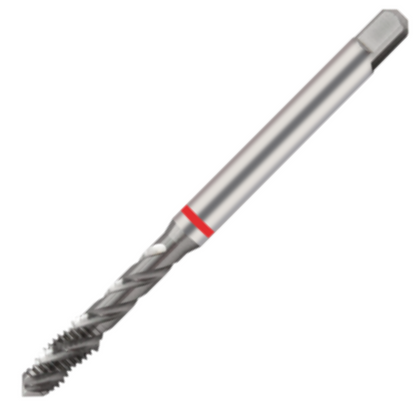
Heat Resistant Alloys & Titanium
The difficult end. These work-harden the moment the tap dwells, so they want a sharp edge, a steady feed and no rubbing.
Shop Heat Resistant Alloys & TitaniumUniversal
Taps rated to cut across the material groups. The sensible default for a jobbing shop, or a toolbox that has to handle whatever comes through the door.
Shop UniversalHow to identify a thread form
Flank angle separates the families faster than anything else. Measure it with a thread gauge and most of the guesswork disappears.
| Thread form | Flank angle | Written as | How it seals / fits | Where you'll find it |
|---|---|---|---|---|
| Metric | 60° | M6 × 1.0 | Straight thread, clamps on the fastener head or a washer | Almost all modern machinery, fixtures and fasteners |
| BSW | 55° | 1/4″ BSW, 20 TPI | Straight thread, mechanical fixing only | Pre-metrication British machinery, classic vehicles, restoration |
| BSF | 55° | 1/4″ BSF, 26 TPI | Straight thread, finer pitch resists vibration | Older British automotive and aerospace assemblies |
| BSPP | 55° | G 1/4″ | Bonded washer, O-ring or captive seal on the face | Hydraulic and pneumatic ports with a flat sealing face |
| BSPT | 55° | Rc 1/4″ | Wedges on the thread flanks, PTFE tape or sealant | UK gas, plumbing and fluid power installation |
| UNC | 60° | 1/4″-20 UNC | Straight thread, mechanical fixing only | American-built plant, machinery and fixings |
| UNF | 60° | 1/4″-28 UNF | Straight thread, finer pitch resists vibration | US automotive and aerospace, thin-wall sections |
| NPT | 60° | 1/8″-27 NPT | Wedges on the thread flanks, PTFE tape or sealant | US pipework, compressed air lines, imported plant |
| NPSF | 60° | 1/8″-27 NPSF | Dryseal straight thread, mates with an NPT external | Fuel, oil and hydraulic port fittings |
| BA | 47.5° | 2BA | Straight thread, mechanical fixing only | Instruments, model engineering, heritage electrical gear |
Pitch is quoted in millimetres for Metric and BA, and in threads per inch (TPI) for the Whitworth and Unified families. A taper thread narrows visibly along its length — a parallel thread does not.
Tapping tooling and accessories
The rest of what you need to cut a thread: holders, wrenches, repair inserts and the dies for external work.


Threading tap FAQs
The questions our technical line gets asked most, answered properly.
How do I work out which thread form I've got?
Measure the major diameter with calipers, then check the pitch with a thread gauge. A 60° flank angle with a round metric pitch means Metric. A 55° flank angle puts you in the Whitworth family — BSW, BSF or one of the BSP variants. 60° with a threads-per-inch count means UNC, UNF or NPT. A 47.5° flank is BA, and nothing else uses it.
If the thread narrows along its length it's a taper thread, which leaves you with BSPT or NPT. A thread pitch gauge costs a few pounds and removes the guesswork entirely.
What is the difference between BSP and NPT?
Flank angle, mostly. BSP runs 55°, NPT runs 60°, so the two will never seat properly against each other even where the diameters look close. The pitches differ too — 1/4″ BSP is 19 TPI against 18 TPI on 1/4″ NPT.
Force one into the other and you damage the softer of the two parts and end up with a joint that weeps under pressure. BSP is the standard across UK and European hydraulics; NPT arrives with American-built plant and compressed air equipment.
BSPP or BSPT — which one do I need?
Look at how the joint seals. BSPP (marked G) is parallel: the thread holds the fitting and the seal comes from a bonded washer, O-ring or captive seal on the face. BSPT (marked Rc or R) is tapered at 1:16, so it wedges as it tightens and seals on the thread flanks with PTFE tape or a liquid sealant.
Flat sealing face on the port means BSPP. Plain tapered hole in a manifold or casting means BSPT.
What tapping drill size do I need?
For metric coarse threads, subtract the pitch from the major diameter. M6 × 1.0 needs a 5.0mm drill, M8 × 1.25 needs 6.8mm, M10 × 1.5 needs 8.5mm and M12 × 1.75 needs 10.2mm.
That gives roughly 75% thread engagement, which is the practical sweet spot. Going deeper adds very little holding strength and a great deal of tap breakage. Forming (roll) taps are the exception — they need a larger hole, around 5.6mm for M6.
Taper, second or plug tap — what is the difference?
It comes down to the lead, meaning how many threads are ground away at the tip. A taper tap has 8 to 10 threads of lead, so it starts square easily and is the one to open a hand-tapped hole with. A second or intermediate tap has 3 to 5 and does most of the cutting. A plug or bottoming tap has 1 to 2, which lets it cut almost to the floor of a blind hole.
A three-piece hand set gives you all three and covers most workshop jobs.
Spiral point, spiral flute or straight flute?
Match it to the hole. Spiral point (gun nose) pushes swarf forward and out of the bottom, so it belongs in through holes and it's the fastest option on a machine. Spiral flute pulls swarf back up and out, which is what a blind hole needs because chips have nowhere else to go.
Straight flute is the general-purpose hand tapping choice and works well in short-chipping materials such as cast iron and brass.
When should I use a forming (roll) tap instead of a cutting tap?
On ductile material — aluminium, copper, mild steel and low-carbon stainless. A roll tap displaces metal instead of cutting it, so there is no swarf at all. That removes the single biggest cause of breakage in blind holes, and the thread comes out stronger because the grain flow follows the form rather than being cut through it.
The catch is the drill. A forming tap needs a larger hole than a cutting tap: around 5.6mm for M6 rather than 5.0mm. Use the cutting-tap drill and you will snap it.
HSS, HSS-E or solid carbide — which tap material?
HSS handles mild steel, aluminium and general workshop material, and it's the cheapest per hole. HSS-E is cobalt-alloyed, keeps its edge at higher temperature and is the sensible pick for stainless, tool steel and tougher alloys.
Solid carbide is for cast iron, abrasive materials and high-volume production on a rigid machine. It lasts far longer but it's brittle, so any misalignment or spindle deflection will break it.
Why do my taps keep breaking?
Nine times out of ten the tapping drill is undersized. A 4.8mm hole where an M6 tap wants 5.0mm roughly doubles the torque on the tap.
After that, in order: swarf packing into a blind hole (switch to a spiral flute), the tap entering off-square, no cutting fluid, or a worn tap being pushed past its life. If you're rigid tapping on CNC, check the feed matches the pitch exactly — even a small mismatch loads the tap sideways and snaps it.
Can I use a metric tap in an imperial hole?
No. An M6 tap and a 1/4″ BSW tap sit within about half a millimetre of each other on diameter and look near-identical in the drawer, but the flank angles are 60° and 55° and the pitches are different.
Run the wrong one through and you either strip the hole or end up with a fastener that binds partway down and never seats. Identify the thread form before you pick the tap.
What is a BA thread and is it still used?
British Association — a miniature metric-based standard with a 47.5° flank angle, which nothing else uses. 0BA is 6.0mm major diameter with a 1.0mm pitch, and the sizes get smaller as the number rises, down to 25BA.
It's still specified for instrument work, model engineering, older electrical switchgear and heritage restoration, so it tends to be a thread you either never touch or need constantly.
Do you stock left-hand, oversize and thread repair taps?
Yes. Left-hand metric taps for anti-rotation applications, metric oversize taps in +0.005, +0.010 and +0.015 tolerances for worn or plated holes, and helicoil taps that cut the specific form a wire insert locks into.
Helicoil taps aren't interchangeable with a standard tap — the minor diameter is different, so a standard tapping drill and standard tap won't give you the right hole. If you need a size you can't see listed, call 01732 887334.
A Metric M6 tap and a 1/4″ BSW tap look almost identical on the shelf. Use the wrong one and you've either stripped the thread or you've got a fastener that binds halfway and never seats. That's why each thread form here has its own collection rather than one long list with a filter bolted on.
Metric covers most production work — it's the ISO standard and what nearly every new machine, fixture and fastener is built around. Start there if you're unsure. BSP, BSPP and BSPT handle pipe and fluid connections across UK and European industry, so anything involving hydraulic fittings, pneumatic lines or gas installation lands in one of those three. BSW and BSF cover older British machinery: classic vehicle restoration, legacy agricultural kit and anything built before metrication took hold.
UNC and UNF are the American coarse and fine equivalents, common on imported plant. NPT and NPSF cover the pipe thread side of the same, particularly compressed air and fuel systems. BA sits on its own — a miniature British standard from 0BA to 25BA used in instruments, electronics and precision assemblies where nothing else fits.
Everything here is available in HSS as a minimum, with HSS-E and solid carbide across most thread forms for tougher materials and higher-volume work.
Can't find the size or specification?
We hold considerably more than we list online, including specials and non-standard pitches. Call and we'll check stock while you're on the phone.
