

Boring Bars
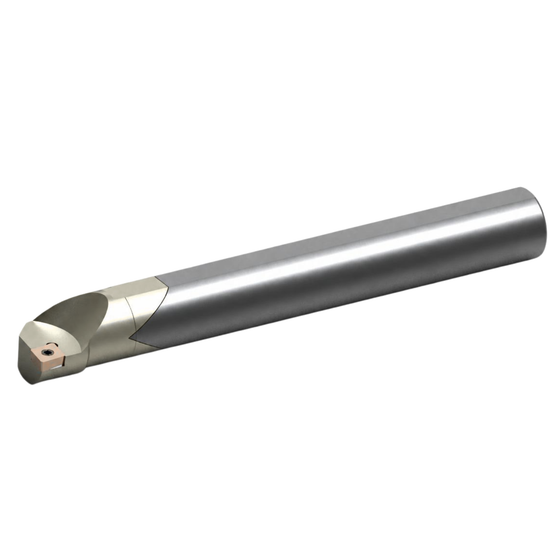
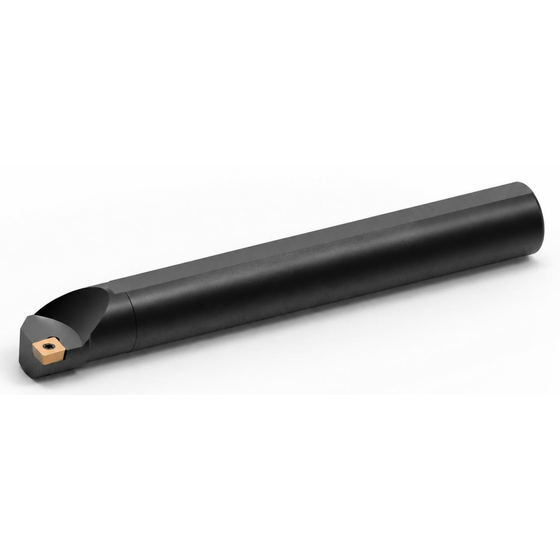
Solid carbide, steel shank and reduced-vibration bars from 4mm to 50mm, for CCMT, DCMT, VCMT and WNMG inserts. Start from the bore you have to cut rather than the insert that happens to be in the drawer.
- 419 boring bars in UK stock
- Order before 4pm, ships same day
- Vortex, Omega and Carmex
- Technical help on 01732 887334
Shop by bar type
Reach and rigidity decide this, not the insert. Every card shows shank range and roughly how far the bar will hang out before it complains.

Solid Carbide Bars
Carbide is around three times stiffer than steel, so the bar stays put where a steel one would start singing. This is what to reach for once the hole is deeper than about four diameters.
Shop Solid Carbide Bars
Steel Shank Bars
Rigid enough at short overhang and a fraction of the price. If the bore is shallow and you are not chasing a mirror finish, there is no reason to spend carbide money.
Shop Steel Shank Bars
Reduced Vibration Bars
Damped HSS shank for the jobs where even carbide rings. Dearer than a plain bar, cheaper than scrapping a part with a rippled bore.
Shop Reduced Vibration Bars
Micro & Small Bars
Where a standard indexable bar will not physically fit. Ground solid carbide, for bores most turning tools cannot enter.
Shop Micro & Small Bars
Through Coolant Bars
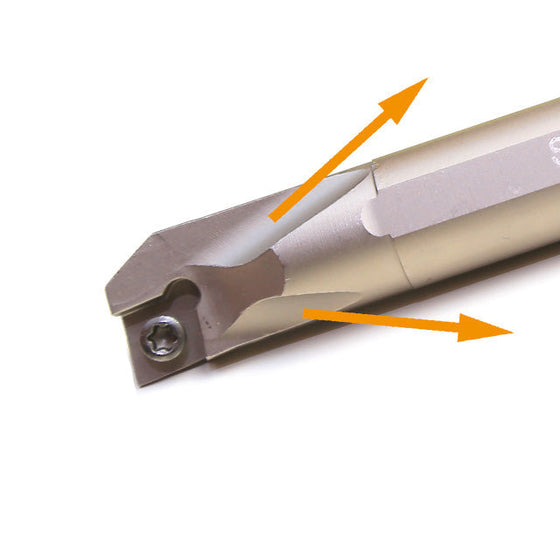
Coolant arrives at the tip and pushes swarf back out of the hole, instead of letting it pack in behind the insert and ruin the bore on the way out.
Shop Through Coolant Bars
Boring Bar Sleeves
Lets a 12mm bar sit properly in a 25mm holder. Cheaper than a second bar, and it keeps the centre height honest.
Shop Boring Bar Sleeves
Boring Heads & Adaptors
For opening a hole on a machining centre rather than a lathe. Adjustable heads, plus the shanks and machinable blanks to mount them.
Shop Boring Heads & Adaptors
All Boring Bars
Every bar we hold, filterable by shank, insert and hand if you would rather browse the lot than be led to it.
Shop All Boring BarsShop by the insert you're running
Already know your insert? Come in this way instead.
CCMT & CCGT
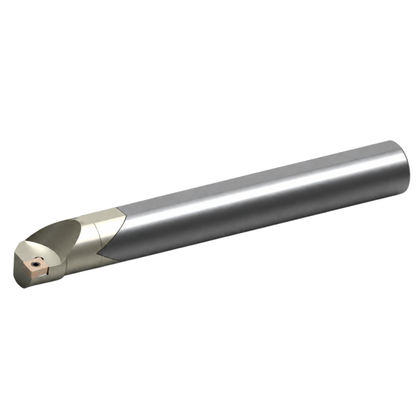
The default for general boring. Strong corner, bores square to a shoulder, and the positive CCGT version cuts light enough for thin wall.
Shop CCMT & CCGT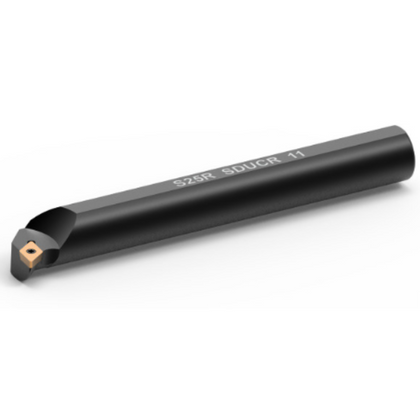
DCMT & DCGT
Narrower nose than a C insert, so it reaches into profiles and undercuts a CCMT would foul on. Slightly weaker corner is the trade.
Shop DCMT & DCGT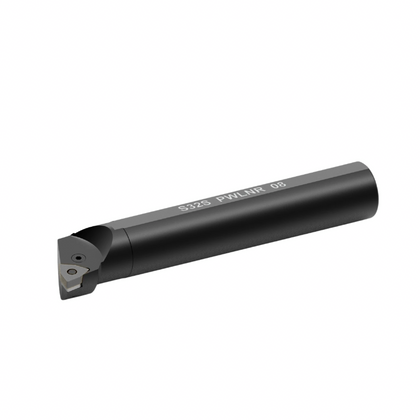
WNMG
Six edges per insert and a strong corner. Roughing choice when the bore is big enough to take the extra cutting force.
Shop WNMG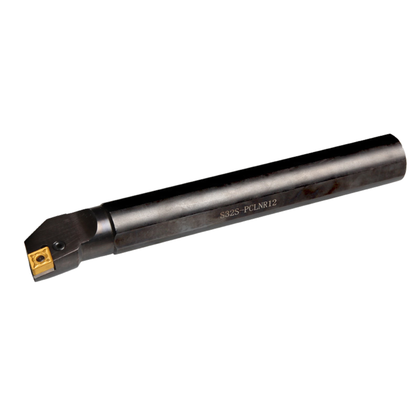
CNMG
Double-sided, so twice the edges of a CCMT at the cost of needing more power and rigidity to drive it.
Shop CNMG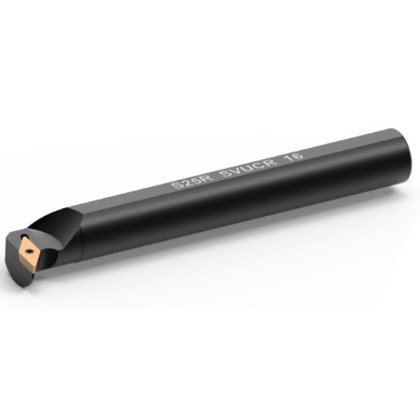
VCMT & VCGT
Sharp point for contours and tight internal profiles. Fragile if you push it — finishing tool, not a rougher.
Shop VCMT & VCGTShop by brand
Two makers cover the range, plus Carmex for the very small end.

Vortex
Steel, carbide and damped HSS shanks in one range, with through-coolant options across most of it. The default for anything mainstream.
Shop Vortex
Omega
Where the 32mm, 40mm and 50mm bars live, plus the reinforced steel shanks with coolant through the body.
Shop Omega
Carmex
Solid carbide tiny tools for bores below what an indexable bar can reach. Ground, not indexed.
Shop CarmexShank material at a glance
Depth is what separates these, not price. The overhang figures are where each shank type starts to misbehave, not a hard stop.
| Shank | Practical depth | Cost | Notes |
|---|---|---|---|
| Steel shank | up to ~4×D | Lowest cost per bar | Shallow bores, general work. Stiff enough until it isn't. |
| Reinforced steel, coolant through | up to ~4×D | Mid | Same rigidity, but swarf gets flushed out of blind holes. |
| Solid carbide | up to ~7×D | Highest | Three times the stiffness of steel. The usual answer to chatter. |
| Damped HSS | 7×D and beyond | Mid–high | Absorbs the vibration rather than resisting it. Last resort before boring from the other side. |
| Sleeve in a larger holder | No change to L/D | Lowest | Fixes fitment, not rigidity. A sleeved bar is no stiffer than the bar itself. |
Depth is quoted as L/D — how far the bar hangs out of the holder, divided by its shank diameter. A 16mm bar at 64mm of overhang is running at 4×D. Those figures assume a decent clamp over at least three diameters of shank; a bar gripped by 20mm of its length will chatter well before the numbers say it should.
Turning, threading and related tooling
The rest of the lathe: the inserts that go in the bars, the holders for outside work, and the drills and reamers that make the hole in the first place.


Boring bar FAQs
The questions our technical line gets asked most, answered properly.
What is a boring bar used for?
Opening an existing hole to a precise finished diameter. A drill gets you a hole roughly where you want it; a boring bar makes it round, straight, on-size and concentric with the spindle. It cannot start a hole — there has to be something there to reach into.
How do I read a designation like S16Q-SCLCR09?
Left to right: S is the shank material (S steel, E solid carbide with coolant, C solid carbide without, A reinforced steel with coolant, H damped). 16 is shank diameter in mm. Q is overall length by ISO code, here 180mm. SCLCR is the clamping and insert geometry — screw clamp, C-style insert, 95° approach — and the final R means right hand. 09 is the insert size.
What approach angle do CCMT and DCMT boring bars have?
A CCMT or CCGT bar is normally 95°, which lets it bore square up to a shoulder. A DCMT or DCGT bar is usually 93°, giving a narrower nose that clears profiles and undercuts. Both are stated on every product page.
What size boring bar do I need for a given bore?
Fit the largest bar the hole will take, leaving clearance for swarf and for the tool to retract. As a starting point the bar should be roughly two thirds to three quarters of the bore diameter. Too small and it deflects; too large and chips jam between bar and wall.
Steel shank or solid carbide?
Steel until the overhang passes about four times the bar diameter, then carbide. Carbide is roughly three times stiffer, which is why it holds size and finish where steel starts to chatter. Below 4×D you are paying for stiffness you are not using.
How deep can I bore before it chatters?
Around 4×D in steel, 7×D in solid carbide, and beyond that you want a damped bar. Those are guides, not limits — a light cut, a sharp positive insert, a smaller nose radius and the shortest possible overhang all buy you extra depth.
What is the difference between a left hand and right hand boring bar?
Which way it cuts. A right hand bar cuts as it travels toward the chuck, which is the normal case on a conventional lathe running forward. Left hand bars are for reverse spindle direction, back boring, and sub-spindle work.
What are the types of boring bar?
By shank: steel, reinforced steel, solid carbide and damped HSS. By clamping: screw clamp, pin lock and lever. By insert: positive geometries such as CCMT and DCMT for lighter cuts, and negative ISO inserts like CNMG and WNMG for roughing. Choose shank first, since that is what fixes how deep you can go.
Do I need through coolant?
In a blind or deep hole, yes. Swarf has nowhere to fall, so it packs in behind the insert, and the bore gets scored on the way out. In a shallow through hole with good chip flow you can manage without.
Can I use a small bar in a larger holder?
Yes, with a reduction sleeve — that is what they are for, and it sets the centre height correctly. Just be clear that a sleeve fixes fitment only. A 12mm bar sleeved into a 25mm pocket is still a 12mm bar and will deflect exactly as much.
Almost every boring problem is a rigidity problem. The bar is a cantilever, and deflection climbs with the cube of how far it sticks out, so doubling the overhang makes the bar eight times more willing to flex. That is why the first question is never which insert, it is how deep the hole is and how much shank you can keep inside the holder.
Work through it in that order. Take the largest shank the bore will accept while leaving room for swarf to escape, clamp at least three diameters of it, and set the overhang to the shortest length that will reach the bottom of the cut. If that lands under about 4×D, a steel shank will hold size perfectly well. Past that, solid carbide buys you roughly three times the stiffness for the same diameter, and past 7×D a damped bar is the honest answer rather than a bigger insert or a slower feed.
The insert matters after that. Positive CCMT and DCMT geometries cut with less force, which is what you want on a long bar or a thin wall, while negative CNMG and WNMG give you more edges and a stronger corner when the bore is large enough to drive them. Nose radius should stay below the depth of cut, and a smaller radius will pull a chattering bar back into line more often than any other single change.
Blind and deep holes need coolant through the bar. Swarf that cannot fall out packs in behind the insert and scores the bore on the retract, which ruins a part that measured correctly on the way in. Everything on this page is UK stock and ships the same day on orders placed before 4pm.
Not sure which bar the bore will take?
Tell us the bore diameter, the depth and the insert you are running and we will tell you what will hold size. We stock more than we list, so it is worth asking if the size is not on the site.
