

Turning Tool Holders
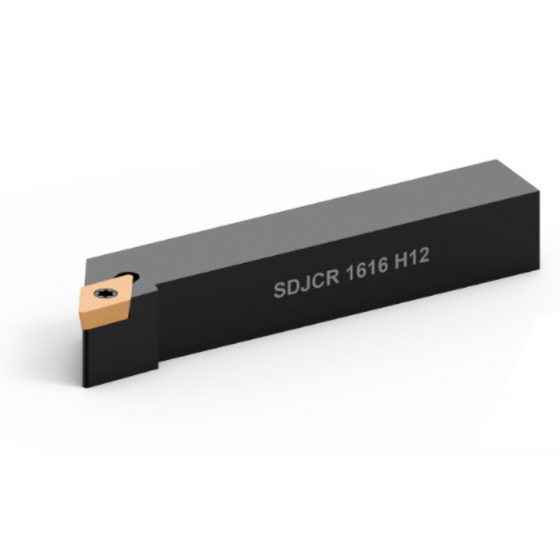
External ISO holders for CNMG, DNMG, DCMT, CCMT, WNMG, VCMT and VBMT inserts. Screw clamp, pin lock and double clamp, in shanks from 8mm to 32mm, right hand, left hand and neutral.
- 358 holders in UK stock
- Order before 4pm, ships same day
- Vortex and Omega
- Technical help on 01732 887334
Shop by insert
Most people arrive knowing the insert they run. Start there, then narrow by shank and clamping once you are in the list.

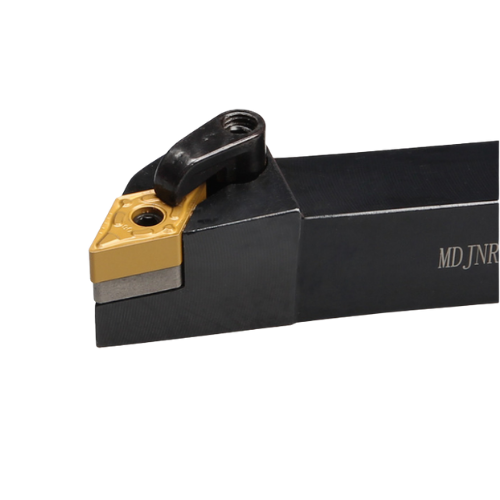
DNMG Holders
Double-sided and tough, with a decent nose angle for general turning. The one most shops reach for when they want edges per insert rather than a delicate finish.
Shop DNMG Holders
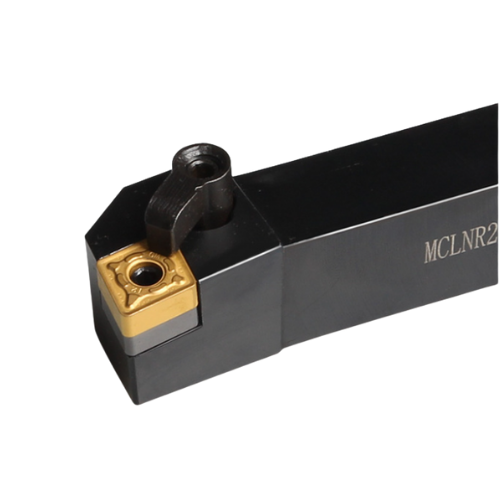
CNMG Holders
Strong corner, four to eight edges depending on the insert, and enough nose angle to take a real depth of cut. Roughing and heavy general turning.
Shop CNMG Holders
DCMT Holders
Positive rake, so it cuts with less force than a negative insert. Good on smaller lathes and where the part or the setup is not rigid.
Shop DCMT Holders
WNMG Holders
Six edges per insert and a very strong corner. The economical roughing choice when you have the power and rigidity to drive it.
Shop WNMG Holders
CCMT Holders
The positive equivalent of a CNMG. Light cutting forces with a strong corner, which makes it forgiving on thin wall and long slender work.
Shop CCMT Holders
VCMT Holders
Sharp 35° point for contours and tight corners. A finishing and profiling tool that will chip if you rough with it.
Shop VCMT Holders
VBMT Holders
Same 35° geometry as a VCMT but clamped rather than screwed through the centre. Choose to match whatever insert you already stock.
Shop VBMT Holders
Round Insert Holders
A round insert has no corner to break, so it is the strongest edge you can run and it leaves a good finish at high feed. Copy work and heavy radius turning.
Shop Round Insert HoldersShop by clamping and shank
How the insert is held decides changeover speed and how well the holder copes with an interrupted cut. Shank size is set by your tool post.
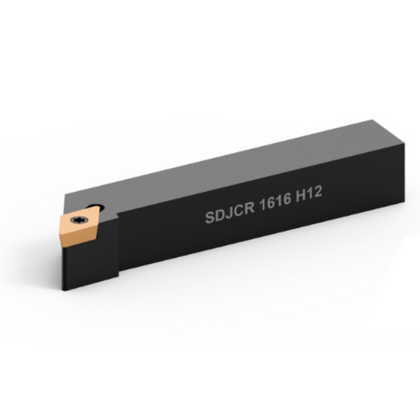
Screw Clamp
The insert bolts straight down through its centre hole. Simplest, lowest profile, and the only option below 16mm shank. Slowest to index when the screw is tight.
Shop Screw Clamp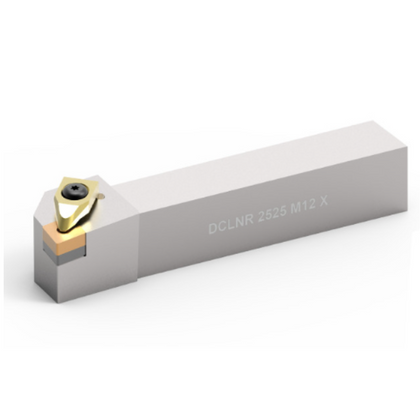
Double Clamp
A top clamp on top of the pin. Holds the insert down through interrupted cuts where a screw alone would let it lift. Bulkier, but it stays put.
Shop Double Clamp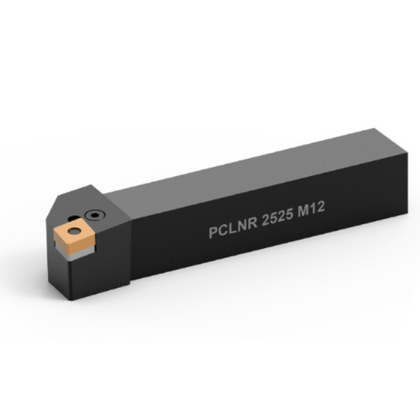
Pin Lock
A lever pulls the insert back onto the pocket wall. Quick to index with the tool still in the post, which is what you want mid-batch.
Shop Pin Lock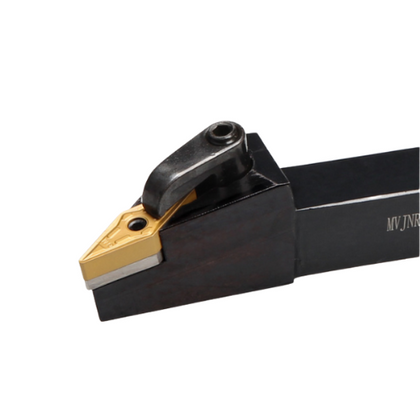
25mm Shank
The deepest part of the range. Standard on most CNC lathes of any size.
Shop 25mm Shank20mm Shank
The other volume size, and the usual fit on smaller CNC and larger manual lathes.
Shop 20mm ShankShop by brand
Two makers cover the whole range, with a lot of overlap in the middle sizes.

Clamping systems compared
All four hold the same insert. What changes is how quickly you can index it, and how well it stays put when the cut breaks.
| System | Changeover | Interrupted cuts | Notes |
|---|---|---|---|
| Screw clamp | Slowest | Fair | Insert bolts through its own hole. Lowest profile and the only choice under 16mm shank. |
| Pin lock | Fastest | Good | Lever mechanism, index without removing the holder from the post. |
| Double clamp | Medium | Best | Pin plus a top clamp. Stops the insert lifting when the cut breaks. |
| Clamp lock | Medium | Good | Top clamp only. Mostly on larger negative-insert holders. |
| Neutral hand | n/a | n/a | 41 holders in the range cut either direction. Useful on sub-spindle and back turning. |
Shank size is the other half of the decision and your machine has already made it for you. Fit the largest shank the tool post will take — a bigger shank is a stiffer tool, and stiffness is most of what decides finish.
Lathe tooling and related ranges
The rest of the lathe bench — what goes in the bore, what cuts the thread, and what holds the very small stuff.


Turning tool holder FAQs
The questions our technical line gets asked most, answered properly.
Which holder do I need for a CNMG insert?
Any holder whose designation carries a C in the second position — MCLNR, PCLNR, DCLNR and so on. The letter after that gives the approach angle, so a CNMG holder at 95° faces and turns square to a shoulder, while 75° is a general roughing angle. Match shank size to your tool post first, then pick the angle.
What does a designation like MCLNR 2020K12 mean?
First letter is the clamping system — M top clamp and pin, P pin lock, S screw clamp, D double clamp. Second is the insert shape, C for CNMG here. Third is the holder style, which sets the approach angle. Fourth is insert clearance. R is right hand. 2020 is a 20 × 20mm shank, K the length code, and 12 the insert size.
Screw clamp, pin lock or double clamp?
Screw clamp is simplest and lowest profile, and below 16mm shank it is the only option. Pin lock indexes fastest because the lever works with the holder still in the post. Double clamp holds the insert down hardest, which matters on interrupted cuts.
What is the difference between a positive and a negative insert holder?
A negative insert like CNMG or WNMG is double-sided, so you get twice the edges, but it cuts with more force and needs a rigid setup. A positive insert like CCMT or DCMT is single-sided and cuts more freely, which suits smaller machines, thin wall and slender work.
What shank size do I need?
Whatever your tool post takes — 20mm and 25mm cover about 60% of this range. Fit the largest shank the machine will hold, since a bigger shank is a stiffer tool and stiffness is most of what decides finish.
Right hand or left hand?
A right hand holder cuts travelling toward the chuck, which is the normal direction on a conventional lathe running forward. Left hand cuts away from the chuck, for facing outward, back turning and sub-spindle work. There are also 41 neutral holders here that will cut either way.
Do I need through coolant?
It helps most on stainless and heat-resistant alloys, where getting coolant to the edge controls both chip breaking and tool life. On mild steel at moderate speed, flood coolant over the top is usually enough.
What approach angle should I choose?
95° faces and turns up to a square shoulder, which is why it is the most common. 93° gives a little more clearance for profiling. 75° and below are roughing angles that spread the load across more of the edge and let you push feed harder.
Can I use the same holder for roughing and finishing?
Up to a point — change the insert grade and nose radius rather than the holder. A large nose radius takes more feed but pushes the part away, so for slender work you want a small radius and a positive insert regardless of which holder is in the post.
What is a neutral holder for?
Cutting in both directions without swapping tools. Handy on twin-spindle and sub-spindle machines, on back turning passes, and anywhere you want to face outward on the return stroke instead of indexing to another station.
A holder is a long-term purchase and the insert is the consumable. It is worth buying the holder that suits the work rather than the one that matches whatever inserts happen to be in the drawer, because you will be running it for years and changing inserts weekly.
If you are opening a hole rather than turning an outside diameter, you want a boring bar instead — different tool, different problem, and rigidity matters far more once the tool is reaching into a bore.
Not sure which holder fits?
Tell us the insert you run, the shank your tool post takes and what you are cutting. We will tell you which holder to order rather than selling you the dearest one.
